Last winter we took the train an hour north to the university town of Uppsala. We found a student cafe, visited the Uppsala domkyrka, walked 5 km along a windy and miserable highway to Gamla (Old) Uppsala, which ended up just being a row of huge mounds.
Wednesday, January 15, 2014
A Snapshot of Buildings in and around Stockholm
My awesome friend Amanda, architect and deep-thinker, asked me a few months ago about the building styles in Sweden. How the buildings feel and how the building environment is different from the US. This is something I have actually thought about often since I moved here.
Our first apartment was in the most gigantic concrete building you've probably ever seen.
But the apartment itself was lovely and modern. On the 10th floor looking out onto a big forest of trees.
Rather than build a town center, or a main street, they built a gigantic shopping mall. This is something I still have trouble with here in Sweden. While the shopping mall is convenient, it just doesn't give me the sense of being in a town or of a community that a main street with (ideally) cute family-owned shops would.
But with everything, once you get on with your life you stop noticing and caring. It just becomes the background to the walk (usually run in my case) to the train.
Living in Stockholm I see a mixture of these two styles: the beautiful, majestic old buildings and the ugly blocks (million homes program.) The million homes project was the government's solution to affordable housing in the late 60's and early 70's.
Here are some examples of the beautiful:
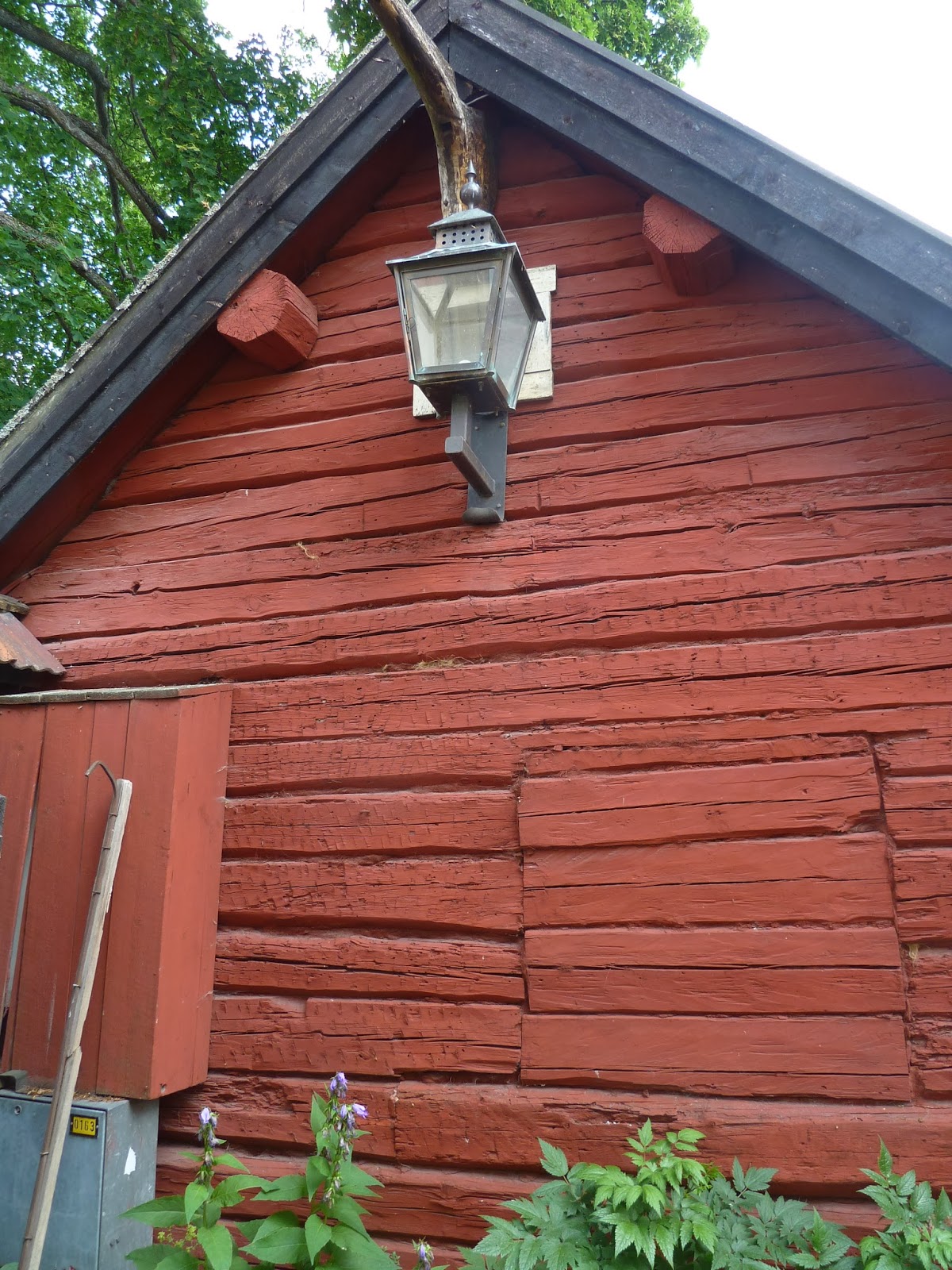
The really old and classic red style (and one green):
And the not so beautiful:
There are a few things I've noticed about the inside of Swedish apartments too, to generalize for a bit... It's not typical for there to be a window in the bathroom. I don't understand why?! Didn't architects think about ventilation? All other windows are not very big. Usually double-paned. Walls are white. Furniture is white, black or brown... it was an expensive struggle trying to find a chair that wasn't one of those three colors.
Our first apartment was in the most gigantic concrete building you've probably ever seen.
But the apartment itself was lovely and modern. On the 10th floor looking out onto a big forest of trees.
Rather than build a town center, or a main street, they built a gigantic shopping mall. This is something I still have trouble with here in Sweden. While the shopping mall is convenient, it just doesn't give me the sense of being in a town or of a community that a main street with (ideally) cute family-owned shops would.
But with everything, once you get on with your life you stop noticing and caring. It just becomes the background to the walk (usually run in my case) to the train.
Living in Stockholm I see a mixture of these two styles: the beautiful, majestic old buildings and the ugly blocks (million homes program.) The million homes project was the government's solution to affordable housing in the late 60's and early 70's.
Here are some examples of the beautiful:
The really old and classic red style (and one green):
And the not so beautiful:
And the interesting:
Nordiska Museet
I visited the Nordic Museum a few months ago and it was filled with, you might have guessed, Nordic cultural objects. Jewelry, ancient kitchen tools, Sami relics, etc.
The building is one of the most beautiful in Stockholm, according to me.
But the thing I liked the most about the museum was that there was a really cool exhibit on stripes:
The building is one of the most beautiful in Stockholm, according to me.
But the thing I liked the most about the museum was that there was a really cool exhibit on stripes:
Tuesday, January 14, 2014
The Trifecta
It's now been a little over a year since I packed up my bags in SF and moved 4000 miles to a country that I had spent approximately 2 weeks in previously. It's been a year of change, not only growing up but also adjusting to life in Sweden. When I told one of my friend Jenny about the recent developments last summer, she congratulated me on the trifecta. Moving to another country, getting engaged and having a baby. It's been quite a year!
I moved 3 times.
Bought an apartment.
Got engaged.
Got pregnant.
Learned a new language.
Made a new group of friends.
Traveled in Russia, Turkey, Denmark and Italy.
Last November I moved in together with my Swedish boyfriend into a 27 m2 apartment outside of Stockholm. In our studio on the 10th floor of an enormous building in Täby, we looked down on forests and the distant lights of Nacka. I could take a 3 minute train ride and find myself in the countryside. Most people cross-country skied around the woods, thick with snow. I ran around the frozen lakes, slipping and catching my breath in the freezing cold air. We moved again 2 months later to a 50 m2 apartment in Södermalm, in southern Stockholm. We slept in a room that fit just our bed, where we joked that we could actually have breakfast in bed (since the stove was an arms length away, accessible by the sliding door that separated the two rooms.) The only view we had was of a big yellow wall with no windows. Södermalm is hip, filled with secondhand shops, record stores, funky cafes, and enough bars and restaurants to keep you busy for years. Several months after arriving, we found out that we had to move again. Such is the fate of secondhand contracts in Sweden. Slowly we started exploring new neighborhoods, taking long walks, scouting hemnet.com for apartments. In September we won the bid on an apartment in Årsta, only we couldn't move in until the end of December. So I find myself here now, the first place I've ever owned. It's 71 m2, with two bedrooms and looks out on a small forest on one side and an elementary school on the other. A place to make our own. I just saw a deer wandering near the window. Our closest establishments are a chocolate boutique, pizza shop, a tattoo parlor & cafe, and a real estate office.
When I first met Micke, I remember hearing this melodic sound, a singsong language that made no sense to me. Just sounds. When I arrived, after taking Swedish classes once a week for several months in SF, the most I could manage was to pick out words from sentences. Airport! They are talking about airports! Or maybe not... It was exhausting and I wanted a nap after short spurts of intense concentration. Slowly, I began to gather more of the surrounding Swedish conversations. I took classes at 3 different schools, with teachers and classmates of varying ability. I met people from all over the world and learned just as much from them as I did about Swedish grammar. In all that time, there was only one other American that I met in my classes. Now it doesn't take the same concentration, I don't translate in my head, it happened without me even noticing the shift. At some point the struggle was gone. There are words that I still don't understand, especially specialized words. There is plenty of room for improvement, but I feel happy when I remember how far I've come. A week after I first arrived in Sweden I was asked about whether I had siblings and I had trouble understanding the question.
As it is with moving to any new place, I've met countless people, most of whom I'll probably never see again. Many brief friendships, with some turning into more meaningful friendships. I always forget how long it takes to really feel settled in a place. In a way it was easier coming to Sweden because I've never moved anywhere with a partner before. It's so easy to just put yourself in your partner's circle of friends. I didn't make the same efforts that I had previously when I was alone in a new city. While friends come and go, as they always do, I feel more secure and happy in the friendships I have made here now.
During a 10 day trip to Turkey last April, on the mediterranean coast, my boyfriend made a romantic scene with a bubble bath and wine, got down on one knee and surprised me by giving me his grandfather's ring that he kept around his neck. While happy beyond belief, I was also stunned and it took me a few days to get used to the idea of being a fiancé. I wasn't the girl who had an idea of my dream wedding or planned out details as a child. I've seen enough divorces to lose the pretense that marriage means happily ever after. I liked the idea of calling someone my husband though and the bond of saying your vows in front of the people that matter most to you. And a huge party. As Micke is a Swede, and we live in Sweden as sambos, with equal rights as those who are married, I just hadn't expected it. I knew he was the person I wanted to spend my life with. We had talked about having a family and made plans for the distant future, but not marriage. It was a wonderful surprise, one that has taken me a while to get used to, but that I look forward to with increasing enthusiasm.
10 days after getting engaged, I looked down at that little white stick that said gravid and realized my hunch had been right. I was pregnant. It took 6 weeks from the day we started trying, 5 months faster than I had anticipated. I tested again 2 days later just to be sure. So here I am today, 4 days past my due date, with the biggest change soon to come. One minute it's only me and Micke but in the next minute there will be another person in the room. In all my 33 years I've just been someone's child and soon I'll be someone's mother. Everyone tells you that children will change your life, change your perspective of everything. It's hard to imagine the course my life will take in the coming years or how this little person will shape me. I can't wait.
Last week I sat with my friend Steve from college and his wife (Micke's sister) and their 4 month old baby. We laughed about how we could have never in a million years have imagined during those years in college that we would one day be family, living in Sweden with our respective Swedish siblings, that our kids would be blood related. I thought it would have been more plausible if we had met people in China (from our shared interest in the region.) He thought Pennsylvania was more likely (since we both grew up there, about an hour apart.)
Ever since my brother passed away when I was 18 from brain cancer, I've made my life about me. Selfishly focusing on enriching my own experiences. I've lived in China, Thailand, Tibet, SF and London. I travelled to remote and incredible places that will forever be a part of me. I spent all the time I could visiting friends and family, because that's what has always been most important to me. I tried any class that interested me, from drawing to acroyoga to Farsi, anything new that kept me from feeling bored by the ho-hum of daily life. In these past months, I've felt a shift to a more domestic role. Focusing on building a home here, making a nice space to raise the baby and thinking about this little family that I have created for myself. It's a new phase of life, unlike anything I have experienced before, and which hopefully will also include some backpacking and adventures along the way as well :)
I moved 3 times.
Bought an apartment.
Got engaged.
Got pregnant.
Learned a new language.
Made a new group of friends.
Traveled in Russia, Turkey, Denmark and Italy.
Last November I moved in together with my Swedish boyfriend into a 27 m2 apartment outside of Stockholm. In our studio on the 10th floor of an enormous building in Täby, we looked down on forests and the distant lights of Nacka. I could take a 3 minute train ride and find myself in the countryside. Most people cross-country skied around the woods, thick with snow. I ran around the frozen lakes, slipping and catching my breath in the freezing cold air. We moved again 2 months later to a 50 m2 apartment in Södermalm, in southern Stockholm. We slept in a room that fit just our bed, where we joked that we could actually have breakfast in bed (since the stove was an arms length away, accessible by the sliding door that separated the two rooms.) The only view we had was of a big yellow wall with no windows. Södermalm is hip, filled with secondhand shops, record stores, funky cafes, and enough bars and restaurants to keep you busy for years. Several months after arriving, we found out that we had to move again. Such is the fate of secondhand contracts in Sweden. Slowly we started exploring new neighborhoods, taking long walks, scouting hemnet.com for apartments. In September we won the bid on an apartment in Årsta, only we couldn't move in until the end of December. So I find myself here now, the first place I've ever owned. It's 71 m2, with two bedrooms and looks out on a small forest on one side and an elementary school on the other. A place to make our own. I just saw a deer wandering near the window. Our closest establishments are a chocolate boutique, pizza shop, a tattoo parlor & cafe, and a real estate office.
When I first met Micke, I remember hearing this melodic sound, a singsong language that made no sense to me. Just sounds. When I arrived, after taking Swedish classes once a week for several months in SF, the most I could manage was to pick out words from sentences. Airport! They are talking about airports! Or maybe not... It was exhausting and I wanted a nap after short spurts of intense concentration. Slowly, I began to gather more of the surrounding Swedish conversations. I took classes at 3 different schools, with teachers and classmates of varying ability. I met people from all over the world and learned just as much from them as I did about Swedish grammar. In all that time, there was only one other American that I met in my classes. Now it doesn't take the same concentration, I don't translate in my head, it happened without me even noticing the shift. At some point the struggle was gone. There are words that I still don't understand, especially specialized words. There is plenty of room for improvement, but I feel happy when I remember how far I've come. A week after I first arrived in Sweden I was asked about whether I had siblings and I had trouble understanding the question.
As it is with moving to any new place, I've met countless people, most of whom I'll probably never see again. Many brief friendships, with some turning into more meaningful friendships. I always forget how long it takes to really feel settled in a place. In a way it was easier coming to Sweden because I've never moved anywhere with a partner before. It's so easy to just put yourself in your partner's circle of friends. I didn't make the same efforts that I had previously when I was alone in a new city. While friends come and go, as they always do, I feel more secure and happy in the friendships I have made here now.
During a 10 day trip to Turkey last April, on the mediterranean coast, my boyfriend made a romantic scene with a bubble bath and wine, got down on one knee and surprised me by giving me his grandfather's ring that he kept around his neck. While happy beyond belief, I was also stunned and it took me a few days to get used to the idea of being a fiancé. I wasn't the girl who had an idea of my dream wedding or planned out details as a child. I've seen enough divorces to lose the pretense that marriage means happily ever after. I liked the idea of calling someone my husband though and the bond of saying your vows in front of the people that matter most to you. And a huge party. As Micke is a Swede, and we live in Sweden as sambos, with equal rights as those who are married, I just hadn't expected it. I knew he was the person I wanted to spend my life with. We had talked about having a family and made plans for the distant future, but not marriage. It was a wonderful surprise, one that has taken me a while to get used to, but that I look forward to with increasing enthusiasm.
10 days after getting engaged, I looked down at that little white stick that said gravid and realized my hunch had been right. I was pregnant. It took 6 weeks from the day we started trying, 5 months faster than I had anticipated. I tested again 2 days later just to be sure. So here I am today, 4 days past my due date, with the biggest change soon to come. One minute it's only me and Micke but in the next minute there will be another person in the room. In all my 33 years I've just been someone's child and soon I'll be someone's mother. Everyone tells you that children will change your life, change your perspective of everything. It's hard to imagine the course my life will take in the coming years or how this little person will shape me. I can't wait.
Last week I sat with my friend Steve from college and his wife (Micke's sister) and their 4 month old baby. We laughed about how we could have never in a million years have imagined during those years in college that we would one day be family, living in Sweden with our respective Swedish siblings, that our kids would be blood related. I thought it would have been more plausible if we had met people in China (from our shared interest in the region.) He thought Pennsylvania was more likely (since we both grew up there, about an hour apart.)
Ever since my brother passed away when I was 18 from brain cancer, I've made my life about me. Selfishly focusing on enriching my own experiences. I've lived in China, Thailand, Tibet, SF and London. I travelled to remote and incredible places that will forever be a part of me. I spent all the time I could visiting friends and family, because that's what has always been most important to me. I tried any class that interested me, from drawing to acroyoga to Farsi, anything new that kept me from feeling bored by the ho-hum of daily life. In these past months, I've felt a shift to a more domestic role. Focusing on building a home here, making a nice space to raise the baby and thinking about this little family that I have created for myself. It's a new phase of life, unlike anything I have experienced before, and which hopefully will also include some backpacking and adventures along the way as well :)
Thursday, December 19, 2013
Dad was in Sweden! (Long Overdue Post)
Dad and Ellen spent their first days in Sweden amidst perfect Indian summer weather in early September. Which I've heard is quite unusual for Sweden, it's usually all rain and cold by that time.
We spent a four busy days taking boat trips around Stockholm, visiting Gamla Stan, eating great food, meeting Micke's family, exploring seaside towns and walking around Djurgården. They were surprised by how flat Sweden is and that the coastal roads north of Stockholm look like most of Sweden, a thick forest of trees. It's definitely not Route 1 along the Pacific.
Here are sunny views from Södermalm:
Below is Sigtuna, the second oldest city in Sweden and one of my favorite places to visit. If it wasn't so far from Stockholm, I would love to live there. It's filled with beautiful old buildings and has a relaxed atmosphere and great views along the water.
We decided to drive a few hours north to the adorable and abandoned fishing village of Skärså. A friend had been there over midsummer when it was bustling, so I was surprised to see that it's one restaurant had already been closed down the first weekend in September! I thought it was lovely anyhow...
We also spent an afternoon visiting new family members in Hammarby Sjöstad and eating lunch in the posh Stockholm neighborhood/harbor of Saltsjöbaden.
We spent a four busy days taking boat trips around Stockholm, visiting Gamla Stan, eating great food, meeting Micke's family, exploring seaside towns and walking around Djurgården. They were surprised by how flat Sweden is and that the coastal roads north of Stockholm look like most of Sweden, a thick forest of trees. It's definitely not Route 1 along the Pacific.
Here are sunny views from Södermalm:
Below is Sigtuna, the second oldest city in Sweden and one of my favorite places to visit. If it wasn't so far from Stockholm, I would love to live there. It's filled with beautiful old buildings and has a relaxed atmosphere and great views along the water.
We decided to drive a few hours north to the adorable and abandoned fishing village of Skärså. A friend had been there over midsummer when it was bustling, so I was surprised to see that it's one restaurant had already been closed down the first weekend in September! I thought it was lovely anyhow...
We also spent an afternoon visiting new family members in Hammarby Sjöstad and eating lunch in the posh Stockholm neighborhood/harbor of Saltsjöbaden.
Wednesday, November 27, 2013
Prenatal Care in Sweden
Today we finished the second day of föräldrautbildning (parental education). In a room with six other couples, we spent several hours talking about anything and everything related to labor, pain management, hospitals and childcare. The midwife who ran the session began by separating us into male and female groups and told us to write down any questions we had. Thus began our discussion. In Sweden, this education is an opportunity that all soon-to-be parents can take advantage of and I feel really grateful for that. It was hugely informative and I was able to express what I was unsure about and get answers. I also learned about things I didn't even know to think about, like TENS (electrical nerve stimulation). We watched a birthing video, but it wasn't really what you would imagine. It was mostly partners being very attentive to their laboring women, women trying out different positions on railings or pilates balls and the use of laughing gas. We also watched a birth where the woman knelt. We also watched a movie about breastfeeding where we learned about baby signals the proper techniques. The fun part was a section about dads' roles... zoom into dads vacuuming, grocery shopping, changing diapers and snuggling with their babies. My general impression is that pregnancy and labor, along with parenting, is really stressed as a partnership here. As it should be!
The other fun thing about this course was that we met two other couples who will be in our new neighborhood, including one couple that live just a few feet down the street from us. Most likely we will all meet again once we are organized into parent groups.
In Sweden, unlike the US, the vast majority of women are attended to by a midwife. When I called the midwife center in May, I was assigned a midwife. Her name is Pirkko and she's awesome. Luckily, since I didn't have any other options! She has seen me every five weeks up until recently, and it's now every two weeks. When I go to the hospital, she won't be there. It's not her job. There will be entirely new crew of midwives that I've never met.
Last week I went on a tour of the labor floor at Södersjukhuset (the hospital where we will likely go.) There are 10 quite enormous rooms and each room looks like it belongs in a hotel. There is a bathtub in 9 out of the 10 rooms, a huge kingsize bed, a TV and sound system where you can plug in music and some contraptions for holding onto when you have a contraction. Each woman gets a room to herself and is assigned a midwife. There is a doctor on duty at all times. For every night that I spend there I will be charged roughly $14.
All things related to prenatal care are free in Sweden, including the visits to your midwife, two ultrasounds and classes to prepare you for being a parent. I had the choice of yoga or lamaze classes. Micke attended a blivande pappor (becoming a dad) course where he could chat with other dudes about how crazy their pregnant partners are and how to handle them, how to raise a baby, questions about labor or whatever else they wanted to talk about. I imagine it was an awesome place to commiserate and/or celebrate becoming a father.
The idea of getting health care in another country has never been an especially appealing thought to me, rather it's something that makes me pretty uncomfortable. It feels unfamiliar and unknown. When I realized that I would most likely be giving birth in Sweden I wasn't sure how the experience would be, I just assumed it wouldn't be as good as the care I would have gotten in the US. Especially once I understood that it's practically rare to see an ObGyn. As it turns out, ironically, having a midwife approach is one of the things that I most appreciate here! They use the philosophy that intervention is a last minute resort and if all is going well, keep pregnancy and labor as simple and natural as possible. Apart from the mean lady at SÖS who told me I was wrong when I said I felt displeased and worried with the way our second ultrasound was conducted, overall it's been great.
The other fun thing about this course was that we met two other couples who will be in our new neighborhood, including one couple that live just a few feet down the street from us. Most likely we will all meet again once we are organized into parent groups.
In Sweden, unlike the US, the vast majority of women are attended to by a midwife. When I called the midwife center in May, I was assigned a midwife. Her name is Pirkko and she's awesome. Luckily, since I didn't have any other options! She has seen me every five weeks up until recently, and it's now every two weeks. When I go to the hospital, she won't be there. It's not her job. There will be entirely new crew of midwives that I've never met.
Last week I went on a tour of the labor floor at Södersjukhuset (the hospital where we will likely go.) There are 10 quite enormous rooms and each room looks like it belongs in a hotel. There is a bathtub in 9 out of the 10 rooms, a huge kingsize bed, a TV and sound system where you can plug in music and some contraptions for holding onto when you have a contraction. Each woman gets a room to herself and is assigned a midwife. There is a doctor on duty at all times. For every night that I spend there I will be charged roughly $14.
All things related to prenatal care are free in Sweden, including the visits to your midwife, two ultrasounds and classes to prepare you for being a parent. I had the choice of yoga or lamaze classes. Micke attended a blivande pappor (becoming a dad) course where he could chat with other dudes about how crazy their pregnant partners are and how to handle them, how to raise a baby, questions about labor or whatever else they wanted to talk about. I imagine it was an awesome place to commiserate and/or celebrate becoming a father.
The idea of getting health care in another country has never been an especially appealing thought to me, rather it's something that makes me pretty uncomfortable. It feels unfamiliar and unknown. When I realized that I would most likely be giving birth in Sweden I wasn't sure how the experience would be, I just assumed it wouldn't be as good as the care I would have gotten in the US. Especially once I understood that it's practically rare to see an ObGyn. As it turns out, ironically, having a midwife approach is one of the things that I most appreciate here! They use the philosophy that intervention is a last minute resort and if all is going well, keep pregnancy and labor as simple and natural as possible. Apart from the mean lady at SÖS who told me I was wrong when I said I felt displeased and worried with the way our second ultrasound was conducted, overall it's been great.
Monday, November 25, 2013
Getting a Swedish Driver's License
It's been months since I last updated this blog and I don't have any great excuses other than I've been preparing baby stuff, studying for tests and bearing the crappiest and darkest month in Sweden. I passed out of SFI (Svenska för Invandrare- Swedish for Immigrants) and then had to take the SAS test (Svenska som Andra Språk- Swedish as a Second Language). According to these tests I apparently have the Swedish level of a 7th or 8th grader.
But the real accomplishment of the month is I passed my driver's license test!!! This may seem like small potatoes to anyone not familiar with the Swedish system, but I assure you, it was an expensive and time consuming ordeal... It goes like this:
1) Apply for a driver's permit
2) Halkbana: Spend 4 hours (mandated) with a group of 11 other people driving as fast as you can on a slippery road course and trying to avoid cones. This actually was really fun and useful. Then we talked about accidents and saw cars like this. There was a lot of the word "slippa" used. As in the instructor hoped that we are able to avoid meeting such a fate.
3) Riskettan: Spend 3 hours (mandated) in a classroom talking about alcohol, wild animals and masculine and feminine driving traits. This also included some very gruesome, and real, footage of traffic accidents. It makes you want to avoid driving and being near any road. Ever.
4) Spend hours and hours reading and rereading 400+ pages of detailed information about such things as how to safely set up a trailer and towing weights, how to drive in different scenarios, eco-driving, the difference between motorways and carriageways (yup! you also have to familiarize yourself with British English too!) how each of the greenhouse gases released from cars affects the environment and humans, catalytic converters, hundreds of signs and what the color of each represents, how to pass on highways, parking rules, reaction speed and braking distances, how many meters away your lights can detect people in light and dark color clothes, statistics of accidents by age groups and by type of accident, knowledge of everything under the hood, child safety and how each component of the car functions (brakes, steering, etc.) among other things.
5) Take 10 online practice tests. Each test has 70 questions, which looks like this:
6) Study more.
7) Take hour long driving lessons where you are reminded that you know nothing about the right hand rule. And if you don't look in the rearview mirror every 5 seconds you will probably fail.
8) Sign up for the theory test, a computerized test of 71 questions on a computer. You have to get at least 52 right out of 65 to pass. There are 5 uncounted questions, but you have no idea which ones they are. This test was hard, way harder than the questions I prepared with. My face got all hot and I was in full panic mode. Most of my questions were scenario questions, for example, a picture of a curve on a country road with a dotted line that turns to a solid line just where there are people picking berries on the side of the road. With most questions there are 4 possible options you can pick from and you must show that you know how to best handle that situation. Or it might be 4 traffic signs and you have to pick which of them (or potentially none) would be seen on a highway.
9) Sign up for the driving test, a 45 minute drive which includes safety checks (lights, tires, brakes, steering and where to find the radiator coolant, motor oil, brake fluid and battery.) Lucky for me I unknowingly signed up for the worst place in the country to take the test: Farsta. http://www.metro.se/stockholm/svarast-i-landet-att-kora-upp-i-farsta/EVHlfB!bJ18WDurVQHns/
Many people don't pass these tests (an average of 46% failure rates in all of Sweden.) When I was still taking my theory test one guy started yelling YES! YES! FINALLY PASSED AFTER 5 MONTHS!!
But my my driving test wasn't bad, the man judging my skills was friendly but not overly chatty. I heard stories of Americans being taunted for their reputation as bad drivers and having to defend themselves while taking the test (which didn't end well.) The traffic school prepared me pretty well for what the instructors would be looking for. I did some small safety checks inside the car, drove on small roads and highways, parallel parked, reversed directions several times and then came back to the center.
Despite all the stress and time, I do think it's helpful to know much of the info and a little embarrassing that I previously lacked basic knowledge about car functions. It also made me think about people driving in Sweden who don't understand the traffic rules here. I listed some of the biggest differences below that I found from driving in the US:
- The righthand rule. Unless you are on a main road (which is shown, sometimes at random, by a yellow diamond sign) you must slow at every junction in case some car arrives on the righthand side, and in which case, they have the right of way. And the fun thing about this is that a road can change from a main road to a non-main road several times within a short span.
- On the highway the car driving on the right lane absolutely can not go faster than the cars on the left.
- If you are involved in an accident you are required to stay there as long as it takes. If the accident involves personal injury, you can be imprisoned if you leave the scene (even as a witness!)
- If you miss a stop sign or run a red light your license will be revoked on the spot.
- No turning on red lights.
- 0.2 mille of alcohol in your body will get you up to 6 months in jail and if it's 1.0 or above you can expect 6 years in jail, plus fines according to your income on both accounts.
I found the severity of traffic offenses really interesting, especially in light of the fact that you might get a similar jail sentence for driving drunk with a 1.0 level as for murdering someone.
But the real accomplishment of the month is I passed my driver's license test!!! This may seem like small potatoes to anyone not familiar with the Swedish system, but I assure you, it was an expensive and time consuming ordeal... It goes like this:
1) Apply for a driver's permit
2) Halkbana: Spend 4 hours (mandated) with a group of 11 other people driving as fast as you can on a slippery road course and trying to avoid cones. This actually was really fun and useful. Then we talked about accidents and saw cars like this. There was a lot of the word "slippa" used. As in the instructor hoped that we are able to avoid meeting such a fate.
3) Riskettan: Spend 3 hours (mandated) in a classroom talking about alcohol, wild animals and masculine and feminine driving traits. This also included some very gruesome, and real, footage of traffic accidents. It makes you want to avoid driving and being near any road. Ever.
4) Spend hours and hours reading and rereading 400+ pages of detailed information about such things as how to safely set up a trailer and towing weights, how to drive in different scenarios, eco-driving, the difference between motorways and carriageways (yup! you also have to familiarize yourself with British English too!) how each of the greenhouse gases released from cars affects the environment and humans, catalytic converters, hundreds of signs and what the color of each represents, how to pass on highways, parking rules, reaction speed and braking distances, how many meters away your lights can detect people in light and dark color clothes, statistics of accidents by age groups and by type of accident, knowledge of everything under the hood, child safety and how each component of the car functions (brakes, steering, etc.) among other things.
5) Take 10 online practice tests. Each test has 70 questions, which looks like this:
6) Study more.
7) Take hour long driving lessons where you are reminded that you know nothing about the right hand rule. And if you don't look in the rearview mirror every 5 seconds you will probably fail.
8) Sign up for the theory test, a computerized test of 71 questions on a computer. You have to get at least 52 right out of 65 to pass. There are 5 uncounted questions, but you have no idea which ones they are. This test was hard, way harder than the questions I prepared with. My face got all hot and I was in full panic mode. Most of my questions were scenario questions, for example, a picture of a curve on a country road with a dotted line that turns to a solid line just where there are people picking berries on the side of the road. With most questions there are 4 possible options you can pick from and you must show that you know how to best handle that situation. Or it might be 4 traffic signs and you have to pick which of them (or potentially none) would be seen on a highway.
9) Sign up for the driving test, a 45 minute drive which includes safety checks (lights, tires, brakes, steering and where to find the radiator coolant, motor oil, brake fluid and battery.) Lucky for me I unknowingly signed up for the worst place in the country to take the test: Farsta. http://www.metro.se/stockholm/svarast-i-landet-att-kora-upp-i-farsta/EVHlfB!bJ18WDurVQHns/
Many people don't pass these tests (an average of 46% failure rates in all of Sweden.) When I was still taking my theory test one guy started yelling YES! YES! FINALLY PASSED AFTER 5 MONTHS!!
But my my driving test wasn't bad, the man judging my skills was friendly but not overly chatty. I heard stories of Americans being taunted for their reputation as bad drivers and having to defend themselves while taking the test (which didn't end well.) The traffic school prepared me pretty well for what the instructors would be looking for. I did some small safety checks inside the car, drove on small roads and highways, parallel parked, reversed directions several times and then came back to the center.
Despite all the stress and time, I do think it's helpful to know much of the info and a little embarrassing that I previously lacked basic knowledge about car functions. It also made me think about people driving in Sweden who don't understand the traffic rules here. I listed some of the biggest differences below that I found from driving in the US:
- The righthand rule. Unless you are on a main road (which is shown, sometimes at random, by a yellow diamond sign) you must slow at every junction in case some car arrives on the righthand side, and in which case, they have the right of way. And the fun thing about this is that a road can change from a main road to a non-main road several times within a short span.
- On the highway the car driving on the right lane absolutely can not go faster than the cars on the left.
- If you are involved in an accident you are required to stay there as long as it takes. If the accident involves personal injury, you can be imprisoned if you leave the scene (even as a witness!)
- If you miss a stop sign or run a red light your license will be revoked on the spot.
- No turning on red lights.
- 0.2 mille of alcohol in your body will get you up to 6 months in jail and if it's 1.0 or above you can expect 6 years in jail, plus fines according to your income on both accounts.
I found the severity of traffic offenses really interesting, especially in light of the fact that you might get a similar jail sentence for driving drunk with a 1.0 level as for murdering someone.
Subscribe to:
Posts (Atom)